Autonomous Infrastructure & Intelligence Systems
Engineered for Resilience.
Built for Reality.
Matthews Operations Lab develops sovereign, zero-dependency infrastructure tools, autonomous edge anomaly engines, and tactical intelligence feeds designed to operate through structural disruptions.
06:30 Daily Brief
A short strategic read every morning: what moved overnight, and whether money and data back the headlines.
Waitlist Join the waitlist 02ANPU
A free, open-source early-warning engine for the people who keep local infrastructure running.
Open source See the public portal 03Offline Emergency Node
Emergency readiness that keeps working with no internet, no account and no app store.
Free View the presentation 04Project Apex
A shielded, off-grid AI node for hospital and municipal emergency operations centers.
In development Read the briefLocal first
Tools run on hardware you control and keep working when networks don't.
Hard signals over headlines
Money, law and measured data come first. Headlines are weighted least.
Explained clearly
Plain language, simple interfaces, and nothing you need a manual to read.
Intelligence · Private distribution
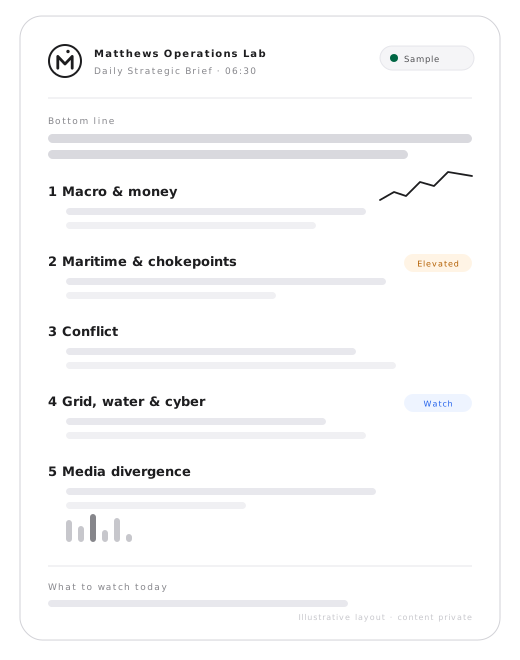
The 06:30 Daily Strategic Brief
Before the day's narrative sets in, you get a short, clear read on what moved overnight and why it matters.
- Five pieces, every day: macro and money, maritime and chokepoints, conflict, grid / water / cyber, and media divergence.
- Money and law before headlines. Every item is checked against markets, regulation and measured data. Headlines alone don't move the read.
- Media divergence. Where coverage from different media blocs tells a different story than the underlying data.
- One line to watch. Each brief ends with what to watch today.
Waitlist
Request the brief
The brief is sent privately to a small circle and added by hand. Join the waitlist and we'll reach out when a spot opens. Your details are only used to send the brief.
Defensive security · Open source
ANPU
Asymmetric Navigation & Preparedness Utilities is a free, open-source early-warning tool for small utilities, facility operators, co-ops and civil defense volunteers. It learns what normal looks like for your own node, tells you in plain English when something stops looking normal, and grades its own accuracy as it runs.
Public portal · ANPU 1.2
See it running
The public portal shows a live read-only demo: current alert level, every signal against its normal, the alert queue, the honeypot labyrinth and the self-graded scorecard.
Phase I · Reconnaissance
Learn what normal looks like
Watches multi-domain signals and scores each one against its own 30-day normal, without alerting anyone watching the network.
Phase II · The Tripwire
The learning labyrinth
A decoy listener on industrial ports (such as Modbus/TCP 502) records who probes it and flags any attempt to write a value.
Phase III · Feedback loop
Gets sharper as you use it
Operators label alerts. False alarms are left out of the next retrain, and real threats are saved as signatures.
What it watches
Built to be trusted
If a feed goes down, ANPU keeps its last good value and marks it stale. It runs replay tests on itself, tracks false alarms per week, and measures early warning: when something real happens, it checks whether it warned you in the 72 hours before.
Collaborate
ANPU is being developed with partners in energy, water and industrial-control security. To collaborate, get in touch.
Community resilience · Free
Offline Emergency Node
A standalone emergency readiness tool, free for any household. Save it once and it keeps working with no internet, no account and no app store.
Critical infrastructure · Open plans
Project Apex
A shielded, air-gapped AI and coordination node for hospital Emergency Operations Centers, municipal utility control rooms and regional emergency management. Apex runs a local language model, searchable protocol libraries and an operations log on its own power, with no internet, cloud or grid connection, so it stays usable through grid failures, cyberattacks and communications blackouts.
Hospitals
Mass-casualty plans, triage and trauma protocols, facility layouts and pharmacy inventories, searchable offline in the EOC.
Municipal utilities
Grid and water system maps, substation logs, distribution points and continuity-of-operations plans, available when SCADA networks and the internet aren't.
Emergency management
A shared, timestamped operations log and resource coordination across agencies during a communications blackout.
Architecture
Rugged rolling transport case (Pelican 1650 class) with custom foam and shock mounts for vehicle transport.
Conductive inner enclosure with continuous conductive gaskets at every seam and honeycomb waveguide vents for airflow, for EMP and RF protection.
Isolated battery power station with pure sine wave output, plus a solar input to extend runtime. No dependence on grid power.
Apple Mac Studio, Ultra-class, with 192 GB+ unified memory for running local language models.
16 to 32 TB NVMe array holding models, vector databases, manuals, maps and OS images.
Fully offline: Ollama or Python runtimes, a local vector database, and a single-file dashboard and manual.
Bill of materials
| Category | Component | Specification | Purpose |
|---|---|---|---|
| Enclosure | Pelican 1650 transport case | Copolymer rolling case, custom high-density polyethylene foam insert | Transport, drop and water protection |
| Shielding | Conductive liner + CuBe gaskets | Metal inner shell or shielded box; continuous copper-beryllium gasketing at seams; honeycomb waveguide vents | EMP and RF interference protection |
| Compute | Apple Mac Studio (Ultra) | M2 or M3 Ultra, 192 GB+ unified memory | Local model inference on dedicated silicon |
| Storage | NVMe RAID enclosure | 16–32 TB over Thunderbolt (e.g. Sabrent Rocket XTRM-Q class) | Offline models, vector DBs, libraries, maps |
| Power | EcoFlow DELTA Pro | 3,600 Wh LiFePO4, expandable to 25 kWh; 3,600 W pure sine inverter | Isolated AC power for compute and peripherals |
| Solar | 400 W monocrystalline panels | Rigid, weatherproof, MPPT charge controller | Recharging off-grid |
| Display | 15.6" 4K industrial monitor | Aluminum housing, DC input | Local dashboard |
| Input | Sealed keyboard + trackpad | IP65, backlit | Local control |
| Grounding | Braided copper strap + ground stake | Chassis bonded to earth ground at fixed sites | Safety and shielding performance |
How it learns, offline
Step A · Retrieval (RAG)
Each site's own documents (protocols, plans, maps, logs) are split into about 500-token chunks with 50-token overlap, embedded locally, and stored in a local vector database (ChromaDB or SQLite). The model answers from those documents.
Step B · Optional fine-tuning (LoRA)
Where strict terminology matters, a small LoRA adapter is trained on the Mac Studio from local prompt and response examples, using tools like Unsloth or LlamaFactory, then registered in Ollama as a site model.
Models
Open-weight 7B to 14B instruction models (e.g. Mistral 7B Instruct, Qwen 14B), quantized to 4 or 5 bits (GGUF Q4_K_M / Q5_K_M).
Bring-up in an outage
- Power on the battery station and confirm the solar input.
- Boot the Mac Studio into its isolated local environment. All services run on
127.0.0.1with no outside DNS. - Open the Apex dashboard and choose an operating profile: Hospital EOC or Municipal Utility.
Community project · Open plans
Build one. Help us build it better.
The plans are published so hospitals, cities and builders can make their own. We're looking for collaborators in shielding and EMC testing, power systems, local AI, and hospital and utility emergency operations.